Hidden Water Damage Signs in Cottonwood Heights, UT
Every year, Cottonwood Heights homeowners discover water damage that has been silently spreading for weeks — or months — before any visible sign appeared. By the time the problem becomes obvious, the cost of water damage restoration in Cottonwood Heights can easily run into the thousands. The good news: water damage leaves clues before it becomes a crisis, and knowing what to look for can save your home and your wallet.
In this post, we cover the 5 most common signs of hidden water damage, why they’re easy to miss in Cottonwood Heights homes, and what to do if you find them.
Think You Have Hidden Water Damage?
Call (877) 698-1311 for a professional moisture assessment in Cottonwood Heights, UT.
Why Hidden Water Damage Matters for Cottonwood Heights Homeowners
Most water damage isn’t the dramatic flood-your-basement type. It’s the slow kind — a pinhole leak in a copper supply line, a hairline crack in a foundation wall that lets in groundwater once a year during spring snowmelt, or an HVAC condensate drain that overflows slightly every warm season. These events don’t announce themselves with standing water. They announce themselves with musty smells and soft spots — months later.
Cottonwood Heights’ climate makes this worse. The alkaline clay soil at the base of the Wasatch Mountains holds moisture against foundation walls far longer than sandy soils would, keeping basement walls and slabs in a chronically damp state that slowly drives moisture into structural materials. Meanwhile, 107 inches of annual snowfall above the city means freeze-thaw cycles stress every pipe joint and foundation crack repeatedly from November through March. The result is that even well-maintained Cottonwood Heights homes can develop hidden moisture intrusion without an obvious triggering event.
Early detection is everything. A water damage event caught within 24 hours typically costs $500–$2,000 to remediate. The same event discovered after 3–6 weeks of undetected saturation often costs $5,000–$15,000 because of the mold remediation, structural drying, and material replacement required.
5 Signs Your Cottonwood Heights Home Has Hidden Water Damage
Musty or earthy smell with no visible source: If a room — especially a basement, bathroom, or closet — consistently smells musty even after cleaning, you likely have mold growing inside a wall cavity, under flooring, or in the subfloor assembly. Mold produces volatile organic compounds (VOCs) that create this distinctive odor well before visible growth appears on surfaces. In Cottonwood Heights homes where basement spaces are adjacent to clay soil, this smell is a significant early warning sign.
Soft or bouncy flooring near walls or plumbing: Wood subfloor that has absorbed water loses structural integrity and becomes noticeably soft or springy underfoot. This is especially common near bathroom toilets, kitchen sinks, and exterior walls where supply lines run through the framing. Press firmly on the floor near these areas — if it flexes more than the surrounding floor, moisture intrusion is likely. Delamination of hardwood floors (boards cupping or crowning) is another indicator of subfloor moisture.
Bubbling, peeling, or stained drywall: Water migrating through wall assemblies saturates drywall paper and causes the paint or texture coat to bubble, crack, or peel away from the surface. Yellow, brown, or rust-colored staining on walls or ceilings indicates water that has dissolved minerals and deposited them as it evaporated. A single stain that reappears after painting is particularly diagnostic — it means the moisture source is ongoing, not a one-time event.
Efflorescence on basement walls or foundation: Efflorescence is the white, chalky, crystalline deposit that forms on masonry surfaces when water carries minerals through the material and deposits them as it evaporates on the surface. In Cottonwood Heights basements, efflorescence on concrete block or poured concrete walls is a reliable indicator that water is regularly moving through the foundation material — a sign that moisture management needs attention before the intrusion escalates to visible water entry.
Unexplained increases in water bills: A water bill that rises without a corresponding increase in water use often indicates a leak somewhere in the supply system — in a wall, under a slab, or in the crawl space. A pinhole leak in a copper supply line may discharge only 5–10 gallons per day (not enough to create immediate visible water), but over a month, that’s 150–300 gallons of water saturating structural materials without your knowledge.
How to Investigate These Signs
Found Any of These Signs?
Cottonwood Heights Water Damage Restoration provides professional moisture assessments. Call (877) 698-1311 or request an appointment online.
What to Do If You Find Hidden Water Damage
If you find one or more of these signs in your Cottonwood Heights home, resist the temptation to paint over stains, replace a section of drywall, or sprinkle baking soda on soft flooring. These responses address symptoms without addressing causes — and leave the moisture source active, continuing to damage structural materials and create conditions for mold growth.
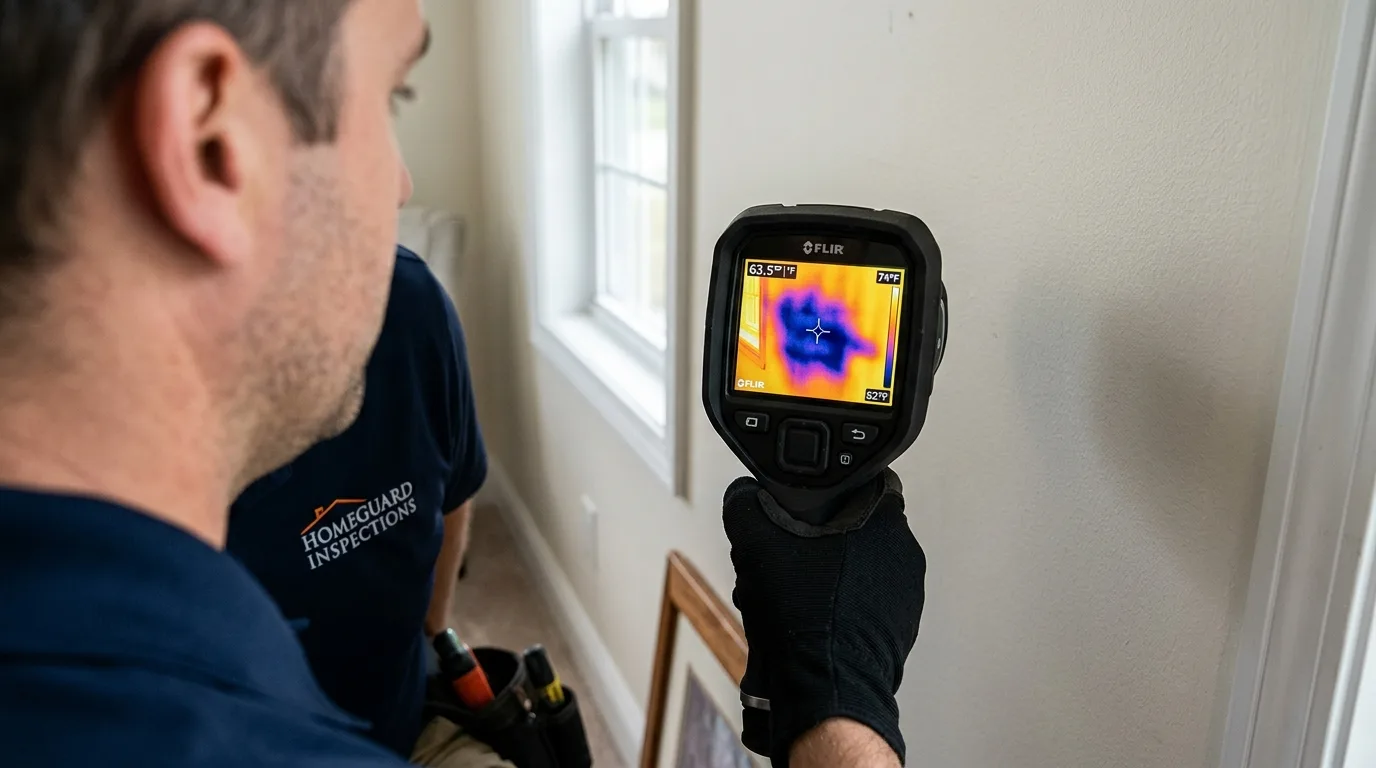
The correct response is professional moisture assessment with calibrated tools. A restoration technician uses thermal imaging cameras to locate temperature differentials inside wall cavities (wet areas cool differently than dry areas), moisture meters to measure actual moisture content in structural materials, and air sampling to assess whether mold is already present in the air. This assessment gives you a factual picture of what’s happening inside your home’s structure — not a guess based on surface appearance.
Types of Hidden Water Damage Sources
Understanding common source types helps you investigate strategically. Supply line leaks typically affect materials within a few inches of the pipe path, causing localized staining or soft spots near fixtures. Foundation intrusion affects perimeter walls and below-grade assemblies, with efflorescence and musty odors as primary indicators. Roof intrusion typically shows up in ceilings and upper wall areas below the roof edge — look for staining or bubbling in the top foot of wall near exterior corners. Condensation from HVAC systems affects the ceiling area below air handlers and the walls adjacent to ductwork in humid conditions — most common in summer when the cooling system is running.
Cost Factors for Hidden Water Damage Repair
How long moisture has been present is the largest cost driver for hidden water damage repair in Cottonwood Heights. A leak detected at 2 weeks may require only drying and patching. The same leak at 8 weeks requires drying, mold remediation, structural material replacement, and full reconstruction — with costs from $3,000 to $15,000+ depending on the extent of material involvement. Across Salt Lake County, the difference between a $1,500 job and a $10,000 job is almost always the detection timeline.
Frequently Asked Questions
How do I know if I have hidden water damage in my Cottonwood Heights home?
The most reliable way to detect hidden water damage is a professional moisture assessment using thermal imaging cameras and calibrated moisture meters. Surface signs — musty smells, stained drywall, soft flooring, efflorescence — indicate probable hidden moisture but cannot tell you the extent or source without instrument-based investigation. If you’ve experienced any water event (burst pipe, basement flooding, roof leak) in the past 12 months, a professional assessment is warranted even if no visible signs are present. Early detection in Cottonwood Heights is especially important given the clay soil’s tendency to maintain elevated moisture levels against foundations.
How much does it cost to assess and repair hidden water damage in Cottonwood Heights?
A professional moisture assessment typically costs $150–$350. If hidden water damage is found, remediation costs range from $500–$2,000 for early-stage detection to $5,000–$15,000 for events that have been active for weeks or months. Homeowners insurance in Cottonwood Heights covers sudden and accidental water damage that is discovered promptly — delayed discovery may affect coverage eligibility depending on your policy terms.
Can I do a hidden water damage inspection myself?
You can look for surface indicators — staining, soft flooring, musty odor, efflorescence — yourself, and these are worth checking seasonally, especially in spring after snowmelt season. However, a DIY inspection cannot tell you whether moisture is present inside wall cavities, under flooring, or in the subfloor. Only thermal imaging and calibrated moisture meters can assess those areas. Professional assessment is the only way to get a complete picture.
Protect Your Cottonwood Heights Home
Early detection is the lowest-cost response to water damage. Call (877) 698-1311 to schedule a moisture assessment.
Related: